



| C-Rations circa 1945 | Meal, Combat, Individual circa 1975 |
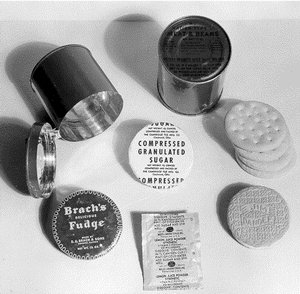 | 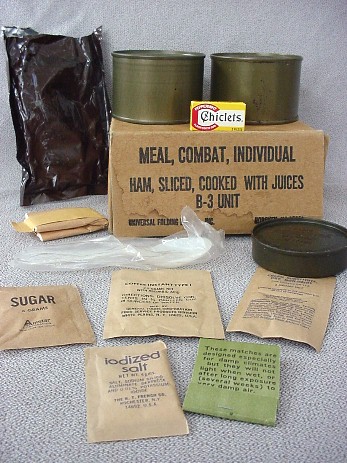 |
The “C-Ration” was first developed just before World War II and was used as the military’s primary “combat” ration until 1958. In 1958, the “Meal, Combat, Individual” officially replaced the C-Ration but the old name stuck. Soldiers didn’t complain about having to eat MCIs – they complained about having to eat “c-rats”. (Check out the 26 year old MCI Fruit Cake Taste Test.)
Here’s a more lengthy history:
On 1 November, 1939, the Adjutant General announced the adoption of field ration C. It consisted of 3 cans containing a meat and vegetable component, and 3 cans, containing crackers, sugar, and soluble coffee; it furnished 2974 calories, 114 grams of protein, and an adequate supply of vitamins and minerals.
C-2 ration
This updated ration is described as an individual ration which consists of packaged pre cooked foods which can be eaten. hot or cold and it replaced the old C ration. It can be carried and prepared by the individual soldier. The ration was designed for feeding combat troops from a few days to an extreme of three weeks. Due to the required individual portability of this ration, maximum nourishment had to be provided in the smallest physical unit. The components of this ration were prepared in 5 different menus. Each menu includes an accessory packet which consists of essential toilet articles, tobacco, and confections.
C-3 ration
The figure “3” in “C-3” represents the third revision of specifications for components of what was known originally as the C ration. This ration is composed of 5 full menus of a greater variety, and in addition to the new and improved B (bread) and M (meat) units, each menu contains an accessory packet, fruit, and cigarettes. The ration weighs 88½ oz., and is packed in 8 small cans; 3 of the cans, 1 for each meal, contain M (meat) components, which offer any one of 10 different varieties of meat; 3 more cans, again, 1 for each meal, include B (bread) components consisting of a unit of .5 crackers and 2 cookie sandwiches, a unit of pre-mixed cereal, jam, crackers, soluble coffee, sugar, cocoa disc, and another unit of crackers and jam. In
addition, the C-3 contains 1-12 oz. can of fruit, the accessory packet, and cigarettes with matches. Field cooking equipment is not required. for the preparation of this ration. The C-3 ration is more adequate than the original C ration in respect to its nutritional value.
C-4 ration
Ration, individual, combat C-4 has been developed recently, and is a modification of the C-3 ration. One modification of the C-3 ration will be the issue of 2-6 oz. cans of fruit for 2 meals to replace the 1-12 oz. can issued for one meal in the C-3. ration.
Toward the end of the Second World War a soldier’s daily C-rations included two accessory packets. The cigarette packet contained a book of matches plus one pack holding nine cigarettes or three smaller packs of three cigarettes each. During the 1960s C-ration cigarettes were identical to the sample packs of four that tobacco salesreps handed out to the public. Pall Mall, Luckies, Winston, Salem and Benson & Hedges Menthol were five of the brands found in Vietnam era field ration packets. C-ration cigarettes were discontinued in 1972.
Meal Combat, Individual
The Meal, Combat, Individual is the first ration which has been adopted to meet the new subsistence concept of supplying nutritionally balanced meals rather than rations. It replaces the Ration, Combat, Individual (C Ration) which was used so extensively in World War II.
The Meal, Combat, Individual, is designed for issue either in individual units as a meal or in multiples of three as a complete ration. Its characteristics emphasize utility, flexibility of use, and more variety of food components than were included in the Ration, Combat, Individual (C Ration) which it replaces. Twelve different menus are included in the specification. Each menu contains one canned meat item; one canned fruit, bread or dessert item; one B unit; an accessory packet containing cigarettes, matches, chewing gum, toilet paper, coffee, cream, sugar, and salt; and a spoon. Four can openers are provided in each case of 12 meals. Although the meat item can be eaten cold, it is more palatable when heated.
Each meal furnishes approximately one-third of the minimum nutrient intake prescribed by Army regulations.
Typical Menus
| Beefsteak | Beefsteak & Potatoes w/ | Boned Chicken |
| Pears | Gravy | Bread |
| B-1 Unit | Pecan Cake Roll | B-3 Unit |
| Crackers (7) | B-2 Unit | Cookies |
| Candy Disc | Crackers (4) | Cocoa Beverage Powder |
| Peanut Butter | Cheese Spread | Jam |
| Accessory packet | Accessory packet | Accessory packet |
Meals/case: 12
Weight/case: 25-26 pounds
Weight/meal (less shipping case): 1.63 pounds
Cube/case: .8713 cubic feet
Cube/meal: .052 cubic feet
Calories/meal: 1200 minimum
Specification: MIL-M-35048
From Homestead.
There were 4 choices of meat in each B group. Because there were several “vintages” of C’s issued to the Marines in Vietnam, more than 4 items may be listed in the B groups as well as the brands of cigarettes included in the accessory
pack.
B-1 UnitsMeat Choices (in small cans): | B-2 UnitsMeat Choices (in larger cans): | B-3 UnitsMeat Choices (in small cans): | *Accessory PackSpoon, Plastic |
C-Ration:
- Development began in 1938 and was completed between 1941 and 1945.
- Used extensively during World War II.
- Issued as one boxed ration per person per day.
- One case of C-Rations contained 6 rations.
- Each ration was composed of a B-unit and a M-unit; total weight was approximately 7 pounds.
- B-unit: (3) 12 ounce cans of bread, coffee and sugar.
- M-unit: (3) 12 ounce cans of meat and vegetable components.
- Limited menu selection [(3) M-units and (3) B-units]; many of the menus contained beans.
- Intended for limited use but sometimes it was used as the sole source of subsistence for weeks.
- Rarely were all of the components available so substitutions with duplicate components were common. This exacerbated menu fatigue.
- Menus were expanded in 1944 to include (10) M-units and (6) B-units.
- Surplus C-Rations were used in both Korea and Vietnam.
Meal, Combat, Individual (MCI):
- Replaced the C-Ration beginning in 1958.
- Used extensively in Vietnam.
- Evolved from the C-Ration (used same metal containers as C-Rations).
- Redesigned food packaging to provide an individual meal rather than an entire ration
- Each MCI weighed approximately 2.7 pounds and contained about 1200 calories.
- Components almost identical to the C-Ration components but with more variety.
- 12 different meals per case with increased variety of canned meats.
- Less monotony and menu fatigue